top of page


STEM with the Saints
“When you seek truth, you seek God whether you know it or not.”
St. Augustine


Did you miss a day?
Don't worry, you can scroll back and catch up!
August 2026
 August 1stIn the Catholic Church, August is dedicated to the Immaculate Heart of Mary. So this month, we are learning how to plan a Marian Garden! A Marian Garden is typically an outdoor space with a Mary where one can quietly pray while surrounded by beautiful foliage. Even though August is late in the growing season, there are many things you can plant in the fall for spring blooming, and even some crops you can plant for a late fall harvest. We hope your garden knowledge really "grows" this month! |  August 2ndHappy Sunday! Have a blessed week! |  August 3rdToday is the feast of St. Lydia Purpuraria, patroness of dyers. To celebrate St. Lydia, we are exploring a variety of plants that can be used to make dyes. Some plants/roots are available in your backyard or even your grocery store, for example: turmeric, goldenrod, and sunflower produce orange and yellow, while elderberries, red cabbage, and blackberries produce blue and purple. To learn more, visit: |
|---|---|---|
 August 4thThis is World Breastfeeding Week and while we typically do not make a connection between gardening an breastfeeding, they share a Catholic value - nourishing God's creation. To reflect on this beautiful act of nourishment, we are highlighting flowers that are named for Our Blessed Mother feeding Our Lord: Dead Nettle (Madonna's Milk) and Bethlehem Sage or Lungwort (Mary's Milkdrop). |  August 5thEvery Wednesday this month, we are going to learn about a wildflower! Wildflowers provide food for many of God's creatures and enrich native soil. Today, we are learning about chamomile! Chamomile is ususally recognized as a soothing tea but it also grows wild in poor soil. Its religious names include Mary's Plant, Maiden Weed, and Lady's Flower. If you want to enjoy a nice cuppa', try some Peppermint Chamomile Tea from @sacredhearttea |  August 6thFeeling parched? We are going to remedy that! Every Thursday this month, we are learning about an important aspect of gardening - irrigation! Irrigation is the process of distributing water to plants and can occur through several methods. Today, we are learning about center pivot irrigation - this irrigation system involves a long pipe with sprinklers that rotates around a central point. This creates a large, circular watered area and is often seen in commercial agricultural operations. |
 August 7thEvery Friday this month, we are going to learn about a plant that you can forage for! Foraging means to harvest from the wild and not from a cultivated crop. The plant we are foraging for today is Mallow and the religious term for it is The Virgin's Bread. Marshmallows, the sweet hot cocoa topping, were once made with mallow and used to be a medicinal treat due to it's anti inflammatory properties. If you'd like to try making marshmallows with real mallow, check out: | 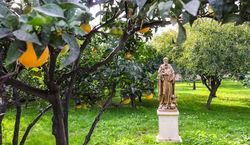 August 8thToday is the feast of St. Dominic, founder of the Dominican order. There is a legend connecting him to an old orange tree enclosed in a courtyard at Santa Sabina on the Aventine Hill in Rome. It is said that St. Dominic planted the seed from which it grew and that every time the orange tree produces a new shoot with much fruit, there would be a corresponding abundance and growth in the Dominican Order. To learn more, visit: |  August 9thHappy Sunday! Have a blessed week! |
 August 10thWe are going to start learning about a more frustrating aspect of gardening, pests. Pests can be a mere nuisance or devastating. Today, we are focusing on Japanese beetles, which destroy roses, fruit trees, raspberries, and beans. While some pesticides are available to deter them, there is also a risk of harming pollinators, which we never want to do. The safest treatment is to use milky spore, a bacterium that kills white grubs of the beetle, but is safe for pets and humans. |  August 11thToday is the feast day of St. Clare, sister of St. Francis. Aligning with the garden theme, St. Clare referred to herself as the "little plant of St. Francis," reflecting the spiritual guidance she found in him. On a winter's day, Francis visited her. As he was leaving, Clare was saddened over his absence. Francis promised they would meet when the roses bloom. Just then, a rose bush bloomed despite the winter snow and Clare returned to the convent with roses to place at the foot of the crucifix |  August 12thOn this Wildflower Wednesday, we are looking for primroses! These nectar rich blooms emerge December through May, peaking in March and April, thus offering a riche source of nectar for pollinators when few plants are in bloom. Primroses are often found in woodlands an its religious names include Our Lady's Keys and Lady's Frills, depending on the exact species. To learn more, visit: |
 August 13thOn this Thirsty Thursday, we are learning about drip irrigation. Drip irrigation is where water drips slowly through pipes that have tiny holes or special drippers. These drippers are spaced out along the pipe. Drip irrigation concentrates the water right near the base of the plant, closer to the roots, so it is very efficient as it uses less water than other methods. This also helps keep nutrients in the soil and reduces erosion. |  August 14thOn this Forage Friday, we are learning about probably the most common, identifiable weed - Dandelion or also known in the Catholic tradition as Mary's Bitter Sorrow, named after its bitter taste. These iconic yellow blossoms are often purged from lawns but they contain several vitamins and minerals and the whole plant can be used, even the roots! So next time you see some, gather them instead of spray them! If you want to learn some ways to use dandelions, visit: |  August 15thToday is the Feast of the Assumption, the day Our Blessed Mother was assumed, body of soul, into heaven. Today is a holy day of obligation so be sure to make it to mass! |
 August 16thHappy Sunday! Have a blessed week! |  August 17thCabbage moths, particularly as caterpillars, are a common pest for plants in the Brassicaceae family, including cabbage, broccoli, cauliflower, kale, and Brussels sprouts. One of the best ways to prevent them from munching on your greens is to protect your plants with a netting, which prevents the moths from laying eggs. Introducing natural predators of the caterpillars, like ladybugs, along with sprinkling diatomaceous earth in your garden, can also help keep your garden lush. |  August 18thSquash bugs, as the name suggests, prey on squash plants, which include pumpkins, melons, and cucumbers. As we are always trying to protect pollinators, we do not encourage strong pesticides and suggest gentler interventions. One safe way to deter squash bugs is to make a mixture of 2 tablespoons of soap and 1 gallon of water, then spray it on the bugs and plants. You can also use row covers and sprinkle diatomaceous earth to deter crawling insects. |
 August 19thOn this Wildflower Wednesday, we are learning about columbine, whose religious name is Mary's Shoes, named for the slipper-like shape. Columbines grow in well-drained soil due to the unique shape of the flower; the nectar can only be reached by select pollinators. These flowers are said to have sprung up under Our Lady's feet as she went to visit Elizabeth. The dove-shaped petals of this flower inspired its use for decoration on the Feast of Pentecost. |  August 20thThis Thirsty Thursday, we are leaning about surface irrigation which is when water covers the top of the soil. This water comes from places like rivers, pipes, or canals which means that a lot water is used and soil nutrients can be washed away. However, this method can help control pests and is very common in rice farming. |  August 21stOn this Forage Friday, we are foraging for Mullein, also known as Our Lady's Candle, due to the fact that it resembles a candlestick. In ancient times, it was often dried then dipped in tallow and used as candles. Mullein is commonly used for respiratory issues and swollen joints, but there are many other applications and ways to process it. To learn how to identify it and use it, visit: |
 August 22ndToday we celebrate the feast of St. Rose of Lima, patroness of gardeners and Latin America. She was the first person born in the Americas to be canonized by the Church and was known for her dedication to her garden, which she used to support her family and the poor. It is said that she would often wear a wreath of flowers on her head, and when people would compliment her beauty, she would pluck a flower from the wreath and give it to them, saying that it belonged to them and not to her. |  August 23rdHappy Sunday! Have a blessed week! |  August 24thToday is the feast of St. Bartholomew, patron of nerve pain and nervous conditions. To celebrate, we want to highlight some plants that have been used to support the nervous system. St. John's Wort is frequently used to help with overall mood and pain but should be taken after consulting with a physician. Ginger, commonly found in the grocery store, is an excellent root that can reduce inflammation in the gut and joints and is very safe. To learn more, visit: |
 August 25thToday, we are learning about another plant nemesis, aphids, which are very small insects that feed on the sap of young plants and new buds. The damage inflicted by aphids results in stunted growth and leaf curling. Luckily, there are some great methods to deter these pests. Using a cinnamon spray and encouraging natural aphid predators like ladybugs are extremely efficient ways to naturally control aphids while protecting other beneficial insects. |  August 26thFor today's Wildflower Wednesday, we are hunting for Meadowsweet, also referred to Our Lady's Belt and Queen of the Meadow due to it being found in abundance in damp meadows. Meadowseet, with its clusters of small white blooms and sweet fragrance, is another excellent plant for pollinators and its very hardy. Aside from supporting beneficial insects, meadowseet is traditionally used as a pain reliever, often thought of as nature's aspirin. To learn more about its history and how to use it visit: |  August 27thThis Thursday, we are learning about sub-surface irrigation which is when water comes from below the ground. This method creates an artificial water table, meaning that water is placed right where the plant roots can reach it. Water can seep into the soil from canals that run near or through the farm. This is often accomplished by burying with holes for water to seep through. |
 August 28thFor this Foraging Friday, we are loolking for violets, also known as Our Lady's Modesty! Violets offer and early spring source of food for pollinators and for humans can help soothe coughs and upset stomachs but there are several uses that you can learn about and try yourself. To learn more, visit: |  August 29thTomorrow we celebrate the Feast Day of St. Fiacre, a 7th century Irish monk and patron of herbalists and gardeners. Although born to wealth, he chose a monastic life and traveled to France, where he gardened and tended the sick with his natural remedies. His reputation as a healer and holy man grew, resulting in the establishment of a hospice when he spent the rest of his life caring for others. Hopefully, St. Fiacre serves as an inspiration for us to care for all of God's creation. |  August 30thHappy Sunday! Have a blessed week and we look forward to starting a new month this week! |
 August 31stToday is the feast of St. Raymond Nonnatus, patron of pregnant women. To celebrate, we are learning about a couple of plants that can support pregnant women. One of the common herbs for pregnant women is red raspberry leaf, which can help with labor but it is also rich in minerals that support the health of mom and baby. Peppermint and ginger can help with nausea, and lemon balm, a member of the mint family, can be soothing for the mind and stomach. For additional herb suggestions, visit: |
To learn more about a featured subject, click on the photo.
Want to skip ahead?
Awesome - you can scroll forward!


bottom of page